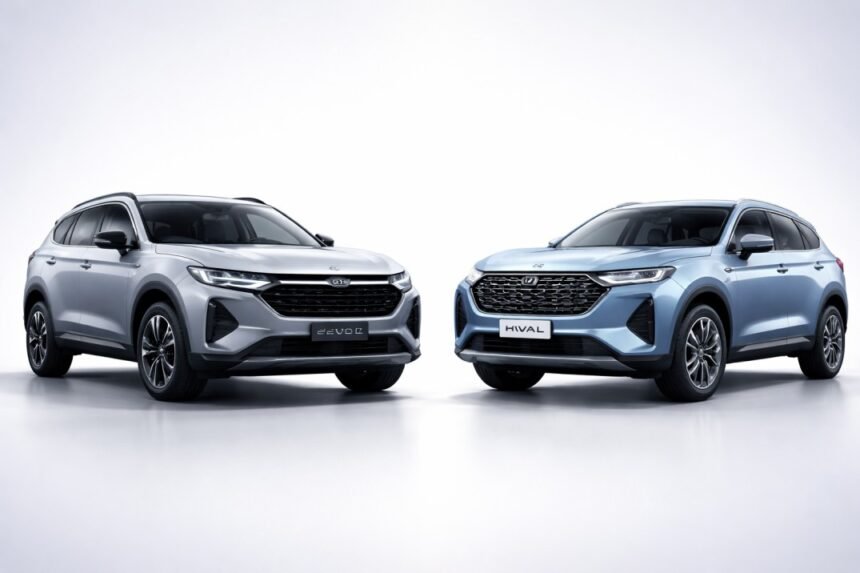
The first two months of 2026 have delivered a fascinating showdown in the automotive world. Two Chinese automotive powerhouses—Jaecoo (under Chery Group) and Haval (under Great Wall Motor)—are locked in an intense battle for supremacy across global markets. With both brands expanding aggressively into Pakistan, the Middle East, Africa, and Europe, the question on every car enthusiast’s mind is: who is winning?
This comprehensive analysis dives deep into the sales figures, market trends, and strategic moves that have defined the Jaecoo vs Haval rivalry in January and February 2026, with special focus on the Pakistani market and the broader international landscape.
The Global Picture: Two Titans, Two Trajectories
Before diving into country-specific performance, it’s essential to understand the parent companies behind these brands. Haval operates under Great Wall Motor (GWM), a veteran Chinese automaker with decades of experience and deep distribution networks. Jaecoo, meanwhile, is part of the Omoda & Jaecoo subsidiary of Chery Group, which has been making aggressive moves into Western markets with remarkable speed.
Chery Group (Parent of Jaecoo) – February 2026
Chery Group reported 160,765 vehicle sales in February 2026, with exports reaching an astonishing 124,929 units—a 41.5% year-on-year increase . This marks the tenth consecutive month that Chery has exceeded 100,000 in monthly exports. For the first two months of 2026 combined.
Great Wall Motor (Parent of Haval) – February 2026
GWM reported February 2026 sales of 43,660 units for the Haval brand specifically, with total group sales reaching higher when including other brands . GWM’s overall January 2026 sales stood at 90,312 units .
While these numbers show GWM’s continued strength, particularly in its home market, the growth trajectory tells an interesting story. Chery’s export growth of 44.7% significantly outpaces many competitors, suggesting that Jaecoo’s international push is gaining momentum faster than Haval’s established presence.
Pakistan: The Crown Jewel of South Asian Competition
Pakistan represents one of the most hotly contested battlegrounds for Chinese automakers. With a growing middle class, increasing SUV preference, and favorable government policies for local assembly, both Jaecoo and Haval have made Pakistan a strategic priority.
Haval’s Stronghold in Pakistan
Haval, assembled and marketed by Sazgar Engineering Works, has established a formidable presence in Pakistan. January 2026 was a breakout month for Sazgar, with total vehicle sales jumping 188.2% compared to December 2025—from 2,139 units to an impressive 6,165 units .
The star performer? Haval contributed 2,004 units to this total, representing a 72% month-on-month increase from December’s 1,165 units . On a cumulative basis for the first seven months of the financial year (July 2025-January 2026), Haval sold 9,214 units, reflecting robust 48.9% growth compared to the same period last year .
The Haval H6 specifically ranked as Pakistan’s second best-selling vehicle overall in January 2026, trailing only the ubiquitous Suzuki Alto . This positioning demonstrates that Haval has successfully penetrated the mainstream Pakistani market, not just the premium segment.
Jaecoo’s Pakistani Entry: The New Challenger
Jaecoo’s parent company, Omoda & Jaecoo, commenced operations in Pakistan in August 2025—a relatively late entry compared to Haval’s established presence . The brand launched with two electric vehicles—the Jaecoo J6 and Omoda E5—followed by locally assembled models including the Jaecoo J7 PHEV and J5 HEV .
While specific Pakistan-only figures for Jaecoo are not separately reported in the available data, the global performance of Omoda & Jaecoo provides context. In January 2026, Omoda & Jaecoo sold 46,875 vehicles internationally, representing 113% year-on-year growth . This figure includes Pakistani sales and demonstrates the brand’s rapid global expansion.
Notably, New Energy Vehicle (NEV) sales reached 17,355 units globally, growing 200% year-on-year—significantly outpacing overall growth . This suggests that Jaecoo’s strategy of emphasizing electrified powertrains is resonating with consumers, including in Pakistan where the J7 PHEV and J5 HEV are now locally assembled.
Pakistan Verdict: Haval Leads, But Jaecoo Shows Promise
Based on January 2026 data, Haval maintains a clear sales advantage in Pakistan. With 2,004 monthly units and the H6 ranking as the country’s second best-seller, Haval has achieved what few foreign brands manage: mainstream acceptance at scale .
However, Jaecoo’s late 2025 entry means direct comparisons are premature. The brand’s global growth rate (113%) and NEV focus (200% growth) suggest that once local assembly ramps up and model availability expands, Jaecoo could become a serious contender. The J7 PHEV, in particular, targets Pakistan’s growing appetite for fuel-efficient SUVs.
| Metric | Haval (Pakistan) | Jaecoo (Pakistan) |
|---|---|---|
| January 2026 Sales | 2,004 units | Part of 46,875 global O&J sales |
| Key Model | H6 (#2 best-seller overall) | J7 PHEV, J5 HEV (new entrants) |
| Growth | 72% month-on-month | 113% global growth |
| Verdict | Established leader | Promising newcomer |
South Africa: A Tale of Two Strategies
South Africa offers perhaps the clearest head-to-head comparison between Haval and Jaecoo, as both report detailed monthly figures to the National Association of Automobile Manufacturers of South Africa (Naamsa).
Haval’s South African Performance
In January 2026, Haval sold 1,629 units in South Africa, ranking as the second-best selling Chinese brand behind Chery (2,258 units) but ahead of Omoda & Jaecoo . The Haval Jolion was the volume driver, with 1,172 units sold—enough to rank seventh among all passenger cars in the country . The Haval H6 contributed another 408 units .
Notably, when including GWM’s other brands (GWM itself sold 892 units in January), the Great Wall Motor group total reached 2,521 units, actually outselling Chery’s 2,258 . This demonstrates GWM’s multi-brand strength in the South African market.
Jaecoo’s South African Performance
Omoda & Jaecoo sold 1,413 units in South Africa during January 2026, placing fourth among Chinese brands . Of these, the Omoda C5 accounted for 907 units (64% of the total), while Jaecoo models (J5 and J7) contributed 506 units .
Breaking down the Jaecoo models specifically: the Jaecoo J5 sold 260 units, while the Jaecoo J7 sold 107 units . These figures place Jaecoo behind not only Haval but also behind Jetour (1,550 units) and its own sibling Omoda brand in the South African market .
South Africa Verdict: Haval Wins on Volume, Jaecoo on Growth Potential
In absolute terms, Haval significantly outsells Jaecoo in South Africa—1,629 units versus 506 Jaecoo-specific sales . The Haval Jolion’s position as the seventh best-selling passenger car overall demonstrates deep market penetration .
However, the combined Omoda & Jaecoo presence (1,413 units) shows that Chery’s multi-brand approach is gaining traction. The Omoda C5’s 907 units demonstrate that consumers are willing to embrace newer brands when the product resonates. For Jaecoo specifically, the J5’s 260 units in its early lifecycle suggests potential for growth as brand awareness increases.
| Chinese Brand | January 2026 SA Sales |
|---|---|
| Chery | 2,258 units |
| Haval | 1,629 units |
| Jetour | 1,550 units |
| Omoda & Jaecoo | 1,413 units (506 Jaecoo) |
| GWM | 892 units |
Europe: Jaecoo’s Surprising Breakthrough
Perhaps the most unexpected development in early 2026 is Jaecoo’s explosive growth in Europe, particularly in the United Kingdom. This represents a direct challenge to Haval’s traditional stronghold in Eastern European markets.
United Kingdom: Jaecoo’s Crown Jewel
In January 2026, Jaecoo sold 4,850 units in the UK, representing a staggering 569.9% year-on-year increase . The Jaecoo 7 alone accounted for 4,059 units, making it the best-selling retail model in the entire UK market and second overall when including fleet sales .
Chery Group’s overall UK and EU sales reached nearly 20,000 units in January, growing 224% year-on-year . Perhaps most impressively, Omoda & Jaecoo took just 17 months to rise from a newcomer to the eighth best-selling brand in the UK—a pace that outstripped Hyundai (27 years to reach 2% share), Kia (18 years), and MG (12 years) .
Russia: Haval’s Eastern European Stronghold
In contrast to Western Europe, Russia remains Haval territory. In January 2026, Haval sold 10,700 units in Russia, ranking second overall behind Lada and maintaining its position as the most popular foreign brand . Haval’s local assembly operations and long-standing dealer network give it a decisive advantage in this market.
Jaecoo’s presence in Russia is more modest, with locally assembled vehicles accounting for just 1.8% of Russian production . The Chery Group has a significant combined presence (Chery, Jaecoo, Omoda, Exeed, Jetour), but individually, Jaecoo trails Haval substantially.
Europe Verdict: A Tale of Two Halves
The European market reveals the fundamental strategic divergence between the two brands:
- Haval dominates Eastern Europe, particularly Russia, where it has achieved market leader status among foreign brands
- Jaecoo is taking Western Europe by storm, with the UK as its flagship market and expansion accelerating into Spain and other EU nations
Neither brand has yet achieved pan-European dominance, but Jaecoo’s Western European breakthrough suggests higher growth potential in premium markets, while Haval’s Eastern European strength provides stable, high-volume returns.
Israel: Jaecoo’s Middle Eastern Triumph
If the UK represents Jaecoo’s Western European success story, Israel is its Middle Eastern masterpiece. In January 2026, Jaecoo ranked second overall among all automotive brands in Israel with 4,519 deliveries—surpassing Toyota (4,465), Kia (4,017), and Skoda (3,569) .
The Jaecoo 7 was the best-selling vehicle in Israel in January with 2,566 units, while the Jaecoo 8 (seven-seat crossover) delivered more than 1,300 units in its first month . February 2026 saw Omoda & Jaecoo achieve 3,678 units, ranking first overall with 13.5% market share—the brand’s first-ever monthly win in Israel .
Haval’s Israel figures are not separately reported in the available data, but Jaecoo’s market leadership position suggests it has decisively outperformed its rival in this key Middle Eastern market.
Head-to-Head Comparison: January-February 2026
Global Sales Momentum
| Metric | Haval / GWM | Jaecoo / Chery | Advantage |
|---|---|---|---|
| Group January Sales | 90,312 (GWM total) | 160,765 (Chery total) | Chery |
| Group Export Growth | Not specified | +44.7% | Chery |
| NEV Growth | Not specified | +200% (O&J NEV) | Chery |
| Key Stronghold | Russia (10,700), SA (1,629) | UK (4,850), Israel (4,519) | Split |
Market-by-Market Winner
| Market | Winner | Key Statistic |
|---|---|---|
| Pakistan | Haval | 2,004 units, H6 #2 best-seller |
| South Africa | Haval | 1,629 vs 506 Jaecoo units |
| United Kingdom | Jaecoo | 4,850 units, 570% growth |
| Russia | Haval | 10,700 units, #2 overall |
| Israel | Jaecoo | 4,519 units, #2 overall |
| Europe (West) | Jaecoo | 20,000 Chery group sales |
| Europe (East) | Haval | Market leader among foreign brands |
What’s Driving the Difference?
Haval’s Advantages
- First-mover advantage in multiple markets, particularly Pakistan and Russia
- Deep distribution networks through GWM’s established presence
- Volume-oriented models like the Jolion that compete in high-demand segments
- Local assembly operations that reduce costs and improve availability
Jaecoo’s Advantages
- New Energy Vehicle focus with 200% NEV growth, appealing to eco-conscious consumers
- Western market targeting with premium positioning and higher margins
- Rapid brand building—17 months to top-8 in UK versus competitors’ decades
- Model differentiation with J7 and J8 targeting specific segments
The Road Ahead: Who Will Win 2026?
As we look toward the remainder of 2026, several factors will determine whether Jaecoo can close the gap with Haval or if Haval will extend its lead.
For Haval to Maintain Leadership
Haval must continue leveraging its established presence in Pakistan, Russia, and South Africa while defending against Jaecoo’s encroachment. The brand’s deep dealer networks and loyal customer bases provide a moat that Jaecoo will find difficult to cross quickly. Additionally, Haval’s parent GWM has announced expanded NEV offerings, which could counter Jaecoo’s electric advantage.
For Jaecoo to Surge Ahead
Jaecoo needs to translate its Western European and Israeli successes into other markets. The brand’s remarkable 113% global growth rate suggests momentum is on its side. In Pakistan, the coming months will be critical as locally assembled J7 and J5 models become more widely available. If Jaecoo can replicate its UK formula—premium positioning, strong NEV focus, and rapid dealer expansion—it could challenge Haval in key battlegrounds.
The Pakistan Factor
Pakistan represents one of the few markets where both brands have made substantial commitments. Haval’s 48.9% cumulative growth demonstrates strong momentum, but Jaecoo’s global NEV growth (200%) suggests that as Pakistani consumers become more fuel-conscious, the J7 PHEV could gain traction. The next six months will reveal whether Jaecoo can carve out significant share or if Haval’s lead is insurmountable.
Conclusion: A Split Decision
So, who is winning the Jaecoo vs Haval battle in early 2026? The answer depends entirely on geography.
Haval leads in Pakistan, South Africa, Russia, and Eastern Europe—markets where it has established deep roots and loyal customer bases. With 2,004 monthly units in Pakistan and the H6 ranking as the country’s second best-seller, Haval’s position appears secure for now.
Jaecoo dominates the UK, Israel, and Western Europe—markets where its premium positioning, NEV focus, and rapid brand building have resonated with consumers. The Jaecoo 7’s status as the UK’s best-selling retail model and Jaecoo’s second-place ranking in Israel demonstrate the brand’s ability to win in sophisticated markets.
Globally, Chery Group’s overall sales and export growth outpace GWM’s, suggesting that the parent company behind Jaecoo has stronger international momentum. However, Haval as an individual brand maintains higher volumes in several key markets.
For Pakistani consumers, this battle is excellent news. Competition between these two Chinese giants means better products, competitive pricing, and expanding dealer networks. Whether you choose Haval’s established reliability or Jaecoo’s innovative NEV focus, the winner in 2026 may ultimately be the Pakistani car buyer.
Frequently Asked Questions
1. Which brand sold more cars in Pakistan in January 2026?
Haval sold 2,004 units in Pakistan during January 2026, with the H6 ranking as the country’s second best-selling vehicle overall behind the Suzuki Alto . Specific Pakistan-only figures for Jaecoo are not separately reported, but the brand commenced local operations only in August 2025 .
2. Is Jaecoo growing faster than Haval globally?
Yes, based on available data. Omoda & Jaecoo (Jaecoo’s parent division) reported 113% year-on-year global growth in January 2026, with NEV sales growing 200% . Haval’s specific global growth rate is not separately reported, but GWM’s overall growth appears more moderate.
3. Which Jaecoo models are available in Pakistan?
Jaecoo launched in Pakistan with the Jaecoo J6 and Omoda E5 (electric vehicles), followed by locally assembled models including the Jaecoo J7 PHEV (plug-in hybrid) and Jaecoo J5 HEV (hybrid electric vehicle) .
4. Why is Jaecoo doing so well in the UK?
Jaecoo has achieved remarkable success in the UK through a combination of premium positioning, strong NEV focus, and rapid dealer expansion. The Jaecoo 7 became the best-selling retail model in the UK in January 2026, and Omoda & Jaecoo reached the top eight brands in just 17 months—a pace that took competitors decades to achieve .
5. Is Haval or Jaecoo better for Pakistani roads?
Both brands offer compelling options. Haval has the advantage of established service networks and proven reliability with models like the H6. Jaecoo offers newer technology, particularly in hybrid and plug-in hybrid powertrains, which may appeal to fuel-conscious buyers. Test drives and comparison of specific models (H6 vs J7 PHEV) are recommended.
6. What is the biggest difference between the two brands’ strategies?
Haval focuses on volume-oriented models and has established deep roots in emerging markets like Pakistan, Russia, and South Africa. Jaecoo targets premium positioning with a strong emphasis on New Energy Vehicles (NEVs) and has found particular success in Western Europe and Israel .
7. Will Jaecoo overtake Haval in Pakistan by the end of 2026?
While possible, it appears unlikely in the short term. Haval’s 48.9% cumulative growth in Pakistan demonstrates strong momentum, and its established dealer network and customer base provide significant advantages . However, if Jaecoo’s global NEV success translates to the Pakistani market, it could capture significant share in the growing hybrid segment.
8. How do the parent companies compare?
Chery Group (Jaecoo’s parent) reported 160,765 February sales and became the first Chinese automaker to surpass 6 million cumulative exports . Great Wall Motor (Haval’s parent) reported 43,660 Haval-specific February sales, with total group sales reaching 90,312 in January . Chery shows stronger export momentum, while GWM maintains robust domestic performance.
*Data sources: Pakistan Stock Exchange filings, PAMA, naamsa South Africa, Chery Group official releases, Great Wall Motor official releases. All figures are for January-February 2026 unless otherwise noted.*