
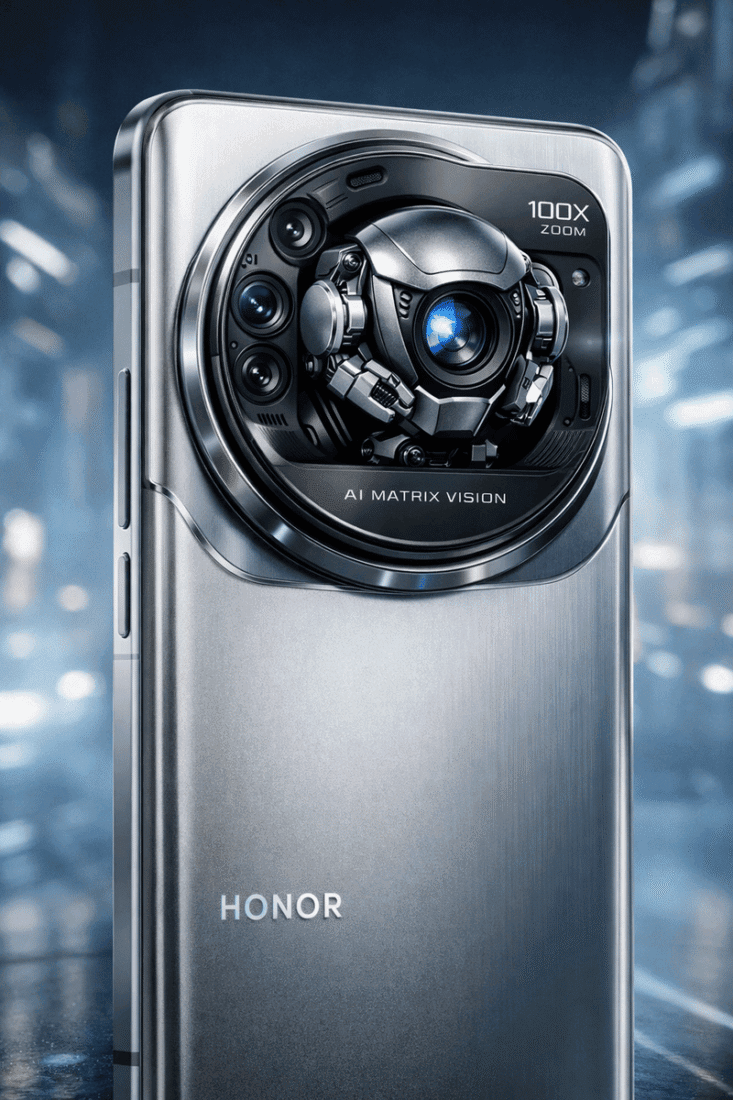
The future of smartphones has just taken a dramatic leap forward. At the Mobile World Congress (MWC) 2026 in Barcelona, Chinese tech giant Honor unveiled a device that looks like it stepped straight out of a sci-fi movie: the Honor Robot Phone .
This is not just another incremental update with a better processor or a slightly improved screen. The Honor Robot Phone, officially presented on March 1, 2026, is a complete reimagining of what a smartphone can be . By integrating a motorized, articulating camera arm directly into the device, Honor has blurred the lines between a handset, a professional gimbal, and an interactive companion . This article dives deep into every aspect of this groundbreaking device, from its innovative camera to its expected price and full specifications.
What is the Honor Robot Phone? A New Species of Smartphone
The Honor Robot Phone is the world’s first commercially planned smartphone to feature a fully integrated robotic camera module . Instead of a fixed camera bump on the back, the device houses a 200-megapixel camera sensor on a miniature, high-precision 3-axis gimbal that physically rises and moves from the phone’s body .
This is made possible by Honor’s development of a custom micro-motor, approximately 70% smaller than existing market alternatives, which powers the phone’s mechanical arm . The arm itself is constructed using the same high-strength materials (with 2800 MPa tensile strength) found in the hinge of Honor’s Magic V6 foldable, ensuring durability despite the complex moving parts . It represents the first major product under Honor’s “ALPHA PLAN,” a strategy to transform from a smartphone maker into a leading AI terminal ecosystem company .
Launch Date and Availability
The Honor Robot Phone was officially unveiled at Honor’s “AI Device Ecosystem Era” showcase at MWC Barcelona on March 1, 2026 .

Honor has confirmed that the Robot Phone will move beyond the concept stage and is scheduled for a commercial release in the second half of 2026 . The initial launch will likely begin in China, with international availability expected to follow, though specific regional timelines remain unannounced .
Price: How Much Will It Cost?
As of now, Honor has not officially disclosed the pricing for the Robot Phone. However, given the cutting-edge technology, custom micro-motors, and complex engineering involved, analysts and industry watchers expect it to sit firmly in the ultra-premium segment .
Early speculation and reports from the event suggest a price point that could approach or even exceed the $1,500 – $2,000 (or equivalent in local currencies) mark . The final price will ultimately determine if consumers see it as a revolutionary tool or an expensive novelty .
The Star of the Show: Robotic Camera Features
The camera is, without a doubt, the main event. It’s a fusion of hardware and AI that unlocks capabilities no other phone can offer.
200MP Sensor and 4-DoF Gimbal System
At its core, the robotic camera boasts a powerful 200-megapixel sensor . This is mounted on a sophisticated 4-degree-of-freedom (4DoF) gimbal system . This allows the camera to tilt, pan, and rotate independently of the phone body, providing 3-axis mechanical stabilization that goes far beyond standard OIS .
AI-Powered Subject Tracking
Leveraging “embodied AI,” the camera can lock onto a subject—a person, a pet, or an object—and physically move to keep them in frame . Whether you’re walking, running, or moving the phone erratically, the camera compensates in real-time, ensuring your subject remains perfectly centered and stable . This effectively eliminates the need for an external gimbal like a DJI Osmo for most content creators .
AI SpinShot and Cinematic Modes
The phone introduces unique capture modes impossible on traditional devices. AI SpinShot allows the camera to smoothly rotate 90 or 180 degrees to create dynamic, cinematic transitions and pans, all achievable with one-handed use . A dedicated Super Steady mode further enhances video stabilization during high-action scenes .
Expressive Interactions and “Emotional Body Language”
Perhaps the most futuristic aspect is the camera’s ability to interact physically. The module can nod, shake its head, and even dance to the rhythm of music . During video calls, it can track you as you move around the room, acting as a robotic camera operator . Users can also interact with the AI assistant, and the camera will physically respond—nodding for “yes” or gesturing to suggest choices .
Detailed Technical Specifications
Based on the information released at MWC 2026, here is a summary of the confirmed and rumored specifications for the Honor Robot Phone.
Pros and Cons of the Honor Robot Phone
Every first-generation technology comes with its own set of trade-offs. Here’s a balanced look at the advantages and potential drawbacks of the Honor Robot Phone.
Pros: The Game-Changers
- Unprecedented Stabilization: The built-in gimbal offers professional-grade video stability without extra accessories .
- Innovative Content Creation: Features like AI SpinShot and physical subject tracking open up new creative possibilities directly from the native camera app .
- Novel Interaction: The expressive “personality” of the camera makes the device feel alive and offers a new way to interact with your phone beyond the screen .
- High-Resolution Sensor: The 200MP sensor ensures top-tier image quality and detail when conditions are right .
Cons: The Big Questions
- Durability Concerns: Moving parts are traditionally the enemy of dust and water resistance. The long-term reliability and robustness of the mechanical arm are unknown .
- Bulk and Weight: Integrating a gimbal system inevitably adds thickness and weight compared to traditional slab phones.
- High Price: The complex technology will command a premium price, potentially putting it out of reach for average consumers .
- Risk of Gimmickry: If the software doesn’t consistently deliver on the hardware’s promise, the moving camera could be seen as a fun but ultimately unnecessary party trick .
- Power Consumption: Powering multiple micro-motors and a high-res sensor will likely drain the battery faster than standard cameras.
The Verdict: Innovation or Gimmick?
The Honor Robot Phone is undeniably one of the most daring and innovative smartphone designs we’ve seen in years. By successfully miniaturizing gimbal technology and integrating it with a high-end sensor and AI, Honor has solved a real problem for mobile content creators: the need for stable, dynamic footage without extra gear .
The “cute” factor of the nodding, dancing camera also adds a layer of personality that could resonate with users looking for something truly different . However, legitimate questions remain about durability, price, and real-world software utility . For vloggers, action sports enthusiasts, and mobile filmmakers, this phone could be an indispensable tool. For the average user, it will depend on whether the magic of the moving camera justifies the inevitable premium.
Ultimately, the Honor Robot Phone is a bold statement about the future of personal technology—a future where our devices don’t just listen to us, but physically interact with the world and us in return.
Frequently Asked Questions (FAQs)
1. When will the Honor Robot Phone be released?
Honor officially unveiled the phone on March 1, 2026, at MWC Barcelona. The company has confirmed it will be available for purchase in the second half of 2026, starting first in China .
2. How much will the Honor Robot Phone cost?
Official pricing has not been announced yet. Given its advanced technology and premium positioning, it is expected to be an expensive device, with some analysts speculating a price tag in the range of $1,500 or more .
3. What is the camera resolution on the Robot Phone?
The robotic camera module houses a powerful 200-megapixel sensor, allowing for incredibly detailed photos and videos .
4. Is the Robot Phone durable? Won’t the moving camera break?
This is a key question. Honor states they have used advanced materials (the same as in their foldable phone hinges) and developed a custom micro-motor to ensure reliability . However, as a first-generation product with moving parts, its long-term durability and resistance to dust and water remain to be tested in real-world conditions .
5. What is the “AI SpinShot” feature?
AI SpinShot is a unique camera mode that leverages the robotic arm to smoothly rotate the camera by 90 or 180 degrees. This allows users to capture cinematic rotating shots and seamless transitions easily, even with one hand .
6. Does the camera really “dance”?
Yes. In a showcase of its “emotional body language,” the robotic camera module can physically move in sync with music, as well as nod or shake its head in response to commands or suggestions from the AI assistant .
7. Do I still need a gimbal for my phone if I buy this?
For the vast majority of situations, no. The built-in 4DoF gimbal is designed to replace an external stabilizer, providing smooth, steady footage for walking, running, and active tracking shots .